

I recently realized that I’ve photographed the Northern Lights in every single month of the year. So I thought I’d create a post showcasing the aurora across all twelve months – similar to my 12 Months of the Milky Way blog.
The Northern Lights, or Aurora Borealis, are often thought of as a winter-only, cold-weather phenomenon. While it’s true that the chances of seeing them are higher in winter (and for some latitudes, that’s the only time darkness allows), it’s not the full story. Within the Arctic Circle, there are months when the sun never sets, which is why aurora tourism is largely promoted between September and March in those locations. But, there are locations that have the potential to see Northern Lights throughout all the months of the year.
Living at 51°N puts me in a unique position. Although we don’t experience true darkness for nearly six weeks in summer, the skies are still dark enough to capture the aurora when conditions align. Some of the most memorable displays I’ve seen in the Canadian Rockies have actually occurred in May, when nights are short, and we’re limited to astronomical twilight.

A few notes about the aurora:
Colour:
Aurora colours are created when charged particles collide with molecules in Earth’s atmosphere at different altitudes. Green is a common colour seen and is caused by the excitation of oxygen atoms at lower altitudes. Often, the aurora isn’t bright enough to fully activate the cones in our eyes (our colour receptors), so it may appear grey, grey-green, or grey-magenta to the naked eye, even though cameras record more vibrant colours.
Latitude:
Latitude plays a major role. If you’re within the Arctic Circle at the right time of year, aurora sightings can happen almost nightly – provided the weather cooperates, and you know how to interpret aurora and space-weather data to be out at the right moment. Sometimes the aurora only lasts a few minutes, but it can be absolutely brilliant during that brief moment. You have to be ready!
How to See the Northern Lights:
I don’t rely on apps; I read the data. I regularly use resources such as Space Weather Live, SolarHam, GOES magnetometers, and other space-weather tools, and I’ll even monitor webcams in different locations. Learning to interpret this data takes time. While I give presentations that include guidance on reading aurora data, I haven’t written detailed posts on the topic yet. For those wanting to learn more, groups like Alberta Aurora Chasers can be a great resource. Enthusiasts and occasionally researchers or experts will share alerts, discussions, and educational resources when conditions look promising.
I also have information about aurora and many other photography topics in my free Photography Community.
Here are 12 months of Northern Lights photos, including the date, approximate time, time zone, and latitude.
January Northern Lights
Utsjoki, Finland | 70°N | January 8, 2022 | 1:30 EET

I’ve experienced the Polar Night a couple of times while leading photography workshops at Aurora Holidays. Since then, we’ve moved the workshop to March, which makes travel easier for us North Americans and allows for the addition of more landscape-focused shooting. During one January night, we had full-sky aurora until the activity intensified and pushed the aurora oval south as far as Helsinki, giving us a brief break before the lights returned to dance above our cottages once again.
February Northern Lights
Kananaskis, Canada | 51°N | February 3, 2016 | 00:05 MT

My goal on this night was to create a star trail, but when I arrived on location I noticed a glow along the horizon. A quick test shot confirmed it was the Northern Lights. The display wasn’t especially strong, but it was nice to catch hints of red alongside the more familiar green. There was some green remaining on the horizon throughout the night which can make star trails tricky.
March Northern Lights
Utsjoki, Finland | 70°N | March 31, 2024 | 1:00 EET

Back in Utsjoki with Aurora Holidays during Spring Light in Lapland for a March Northern Lights image. The displays were spectacular, with intricate structures dancing across the sky and bursts of vivid colour. One night, we were treated to auroral coronas overhead – an effect where the light appears to radiate from a single point. The group was super excited, but it led to some awkward moments trying to angle cameras straight up on tripods while I crawled around to help people, ensuring I didn’t stand up and appear in their wide angle frames.
This is truly one of the best places to see the Northern Lights, and some of my clients that also live in the Canadian Rockies continue to say their experiences on this workshop made them aurora snobs at home!
April Northern Lights
Banff, Canada | 51°N | April 16, 2021 | 23:50 MT
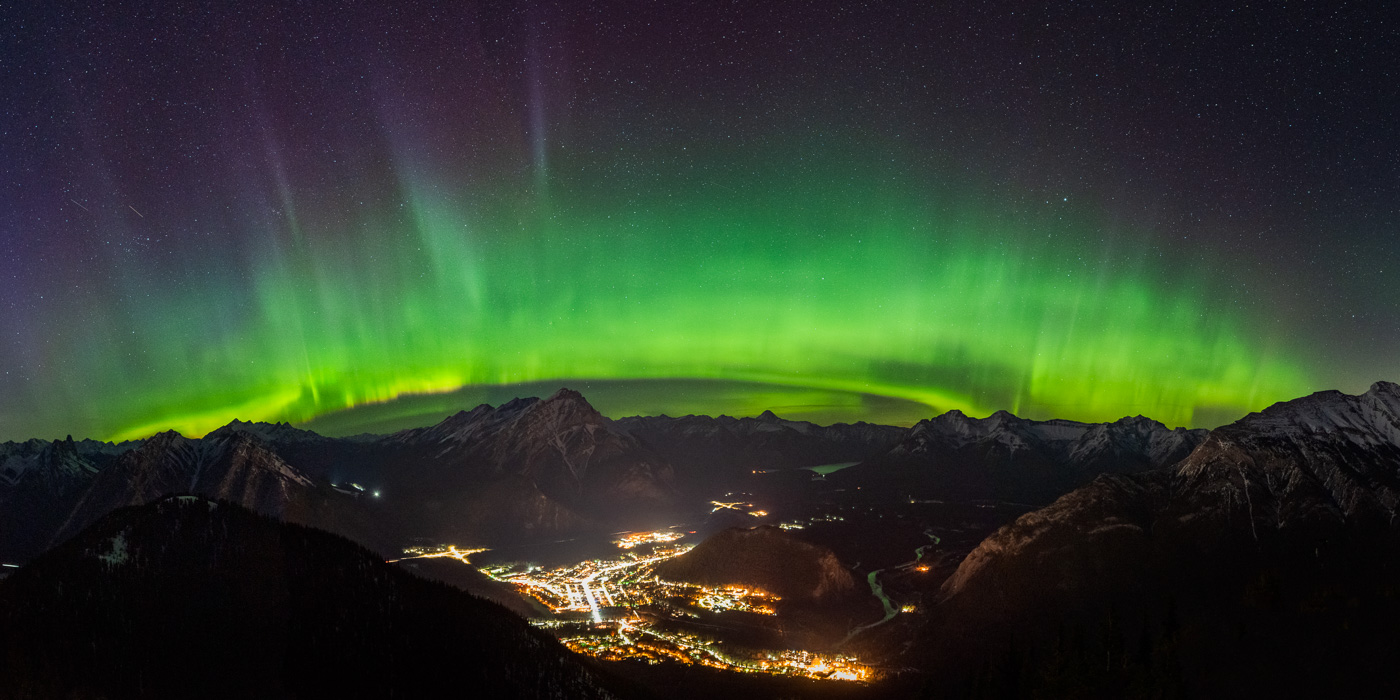
It’s impossible to predict exactly what structures and colours will appear during a northern lights display, but there are some common patterns in auroral behaviour. Often, an arc forms in the northern part of the sky and, around Banff, it usually sits just above the horizon. On this particular night, the aurora arced perfectly over Cascade Mountain and the Town of Banff, eventually becoming energetic enough for distinct structures to emerge and dance across the sky.
May Northern Lights
Jasper National Park, Canada | 52°N | May 10, 2024 | 1:30am MT

On May 10, 2024, we experienced the strongest geomagnetic storm in the last two decades. From 52° north, it brought a wall of colour to the southern sky, while early in the night, there was very little activity to the north for me. Clouds at my original location forced me to drive farther than planned. I had intended to hike up a mountain ridge, but when I reached the parking lot, the weather didn’t match the forecast. It was fully overcast! Instead, I kept driving further and further north until I found clear skies – and it turned out to be the right decision.
June Northern Lights
Dinosaur Provincial Park, Canada | 50°N | June 1, 2025 | 1:30 MT

June 2025 was when I realized I had photographed the Northern Lights in every single month of the year. I was teaching a workshop at Dinosaur Provincial Park with a focus on the Milky Way. The weather had been kind, and we were on our second night of Milky Way photography when the aurora began to dance. By 1 a.m., it had become a full-sky event, and most of the group kept shooting until the sky started to brighten with the rising sun. The sky only got as dark as astronomical twilight, but the aurora still stood out against the sky.
July Northern Lights
Banff National Park, Canada | 51°N | July 8, 2016 | 1:45 MT

I do have aurora images from July without cloud cover, but they’re from my first year of serious night photography, and some of those compositions weren’t the strongest since I had planned for Milky Way friendly locations. So, I’m sharing a cloudy image with aurora. While scrambling in the dark with a friend, hoping to catch the Milky Way, rain started coming down. We tucked ourselves into a slightly sheltered spot beneath a cliff to wait out the weather. That’s when I noticed the clouds beginning to glow, barely breaking just enough to let the aurora show through. I grabbed a few long exposures to capture the movement and colour in the clouds. At least we were rewarded with an incredible sunrise later that morning.
This example also a good reminder that we are always at the mercy of the weather. But if you don’t take chances, travel, or ever try to go out, you’ll never get anything. Some of my favourite images have happened by accident or because I took a chance on some questionable conditions.
August Northern Lights
Kananaskis, Canada | 51°N | August 5, 2019 | 00:30 MT

Another Milky Way adventure unexpectedly delivered a beautiful aurora. There’s something special about the lights showing up as a surprise when you’re already out under clear skies. The Milky Way can be found any night with skies that are dark enough (at a certain illumination, moonlight will wash it out) but at my latitude, the aurora is never a guarantee.
September Northern Lights
South Iceland | 64°N | September 18, 2025 | 21:30 GMT

Many people travel to Iceland hoping to see the Northern Lights, but the weather there can be extremely challenging. I’ve been fortunate to see the aurora on both of my visits, though I know others who have been multiple times without any luck. During one trip, I spent ten days in Iceland and had only a single truly great night of aurora. I tried to stay flexible with my itinerary to chase clear skies, but there was simply a lot of rain and cloud throughout my visit. The forecasts would constantly change, and it was tough to decide on a direction to drive in. I was happy to get the lights over a waterfall.
October Northern Lights
Banff & Kananaskis, Canada | 51°N | October 7 & 10, 2024 | 23:30 & 22:30 MT


After the big May event in 2024, we were treated to two fantastic nights of Northern Lights in October – on the 7th and the 10th. Both displays were bright and colourful, and bright enough that I could easily make out the colours with the naked eye. On the night of the 10th, however, some moonlight washed out the stars and the aurora, giving the display a slightly softer appearance compared to a few nights earlier.
November Northern Lights
Banff, Canada | 51°N | November 11, 2025 | 18:15 & 20:00 MT


On November 11, 2025, the aurora was visible early in the evening. An intense section of pink could be seen easily with the naked eye, bright enough to cast a soft pink glow across the surrounding mountains – a subtle echo of alpenglow, though far less intense. The pink image on the left was captured with my astro-modified camera, which is more sensitive to reds. I did desaturate the image slightly in editing, so it appeared even more intense straight out of camera.
That night, the aurora spanned the full sky with the pink in the North, and the auroral oval extended so far south that my friend Dani was able to see the pinks all the way in Texas.
December Northern Lights
North of Calgary, Canada | 51°N | December 20, 2015 | 1:30 MT

This image comes from my first year of aurora chasing. It’s a simple scene captured on a back road while my friend Mitch and I were hunting for both clear skies and the aurora. The orange wisps on the right are clouds catching light pollution.
If you’re in the right location, it’s possible to see the Northern Lights any month of the year. But it took me ten years to photograph Northern Lights in all twelve months – unfortunately I can’t always drop everything to go chasing. I think my latitude is special for night photography: I can capture the Milky Way core, Northern Lights, and noctilucent clouds, and I have access to plenty of dark-sky areas.
That said, the aurora itself doesn’t appear here all that often. Sometimes it will be strong, but clouds get in the way. Solar maximum can help, since a more active sun theoretically produces more frequent and stronger storms.
When I’m somewhere like Utsjoki, though, my main concern is the weather and getting my group outside at the perfect moment when the data indicates possible activity. Solar maximum doesn’t matter as much there; in fact, lower or moderate activity is often preferred, so the auroral oval doesn’t push too far south, and the lights stay visible.
If you’d like to learn more about night photography, check out my workshops! I also offer virtual mentoring sessions if you’re interested in a personalized session that can be used for anything, like helping you plan images and locations, editing, camera techniques, and more.